
We recently came across an insightful article from Shireen Khan, Senior Associate, Content & Community at ETHRWorld, examining the growing importance of “emotional salary” in today’s talent market.
While competitive compensation remains essential, organizations recruiting Supply Chain and Procurement professionals are increasingly recognizing that career development, flexibility, wellbeing, leadership, and purpose all play a critical role in attracting and retaining top talent.
As competition for experienced professionals continues, these factors are becoming key differentiators for employers.
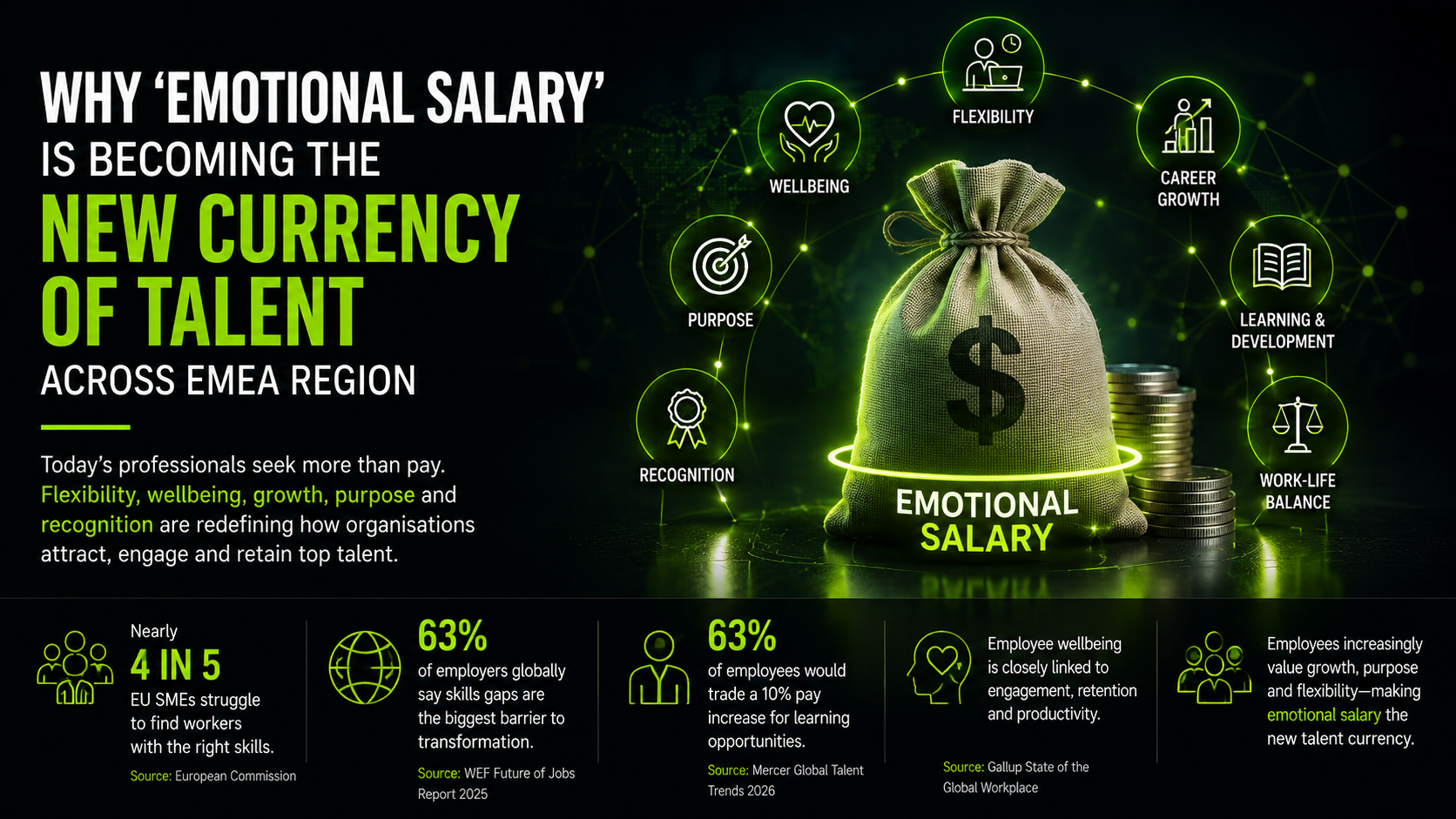
Why ‘Emotional Salary’ is Becoming the New Currency of Talent Across EMEA Region
Published on June 25, 2026 by Shireen Khan
As employers across Europe and the Middle East grapple with persistent skills shortages, rising labour costs and growing employee expectations, a new workplace concept is quietly moving from HR jargon into boardroom discussions: emotional salary.
Unlike traditional compensation, emotional salary refers to the non-financial benefits employees receive from work, including flexibility, wellbeing support, career development opportunities, purpose, recognition and work-life balance. While these elements have long been part of employee experience conversations, organisations are increasingly treating them as strategic tools for attraction and retention rather than optional perks.
The shift reflects a broader reality confronting employers across the EMEA region. In many sectors, talent shortages remain acute despite economic uncertainty, forcing organisations to compete on more than salary alone.
Talent shortages persist despite economic headwinds
The European labour market remains under pressure from demographic change, skills shortages and an ageing workforce.
According to the European Commission, nearly four in five small and medium-sized enterprises across the European Union struggle to find workers with the right skills. The shortage is particularly severe in technology, engineering, healthcare and green economy occupations.
At the same time, the World Economic Forum’s Future of Jobs Report 2025 found that 63% of employers globally identify skills gaps as the biggest barrier to business transformation over the next five years.
In the Gulf, a different but equally pressing challenge is emerging.
Countries including the UAE, Saudi Arabia and Qatar continue to compete aggressively for highly skilled global talent to support economic diversification strategies. As sectors such as artificial intelligence, financial services, renewable energy and advanced manufacturing expand, employers are increasingly competing for the same pool of professionals.
The result is a labour market where compensation remains important, but is no longer sufficient.
Employees are reassessing what work should provide
The growing importance of emotional salary reflects changing workforce priorities, particularly among younger employees.
Gallup’s State of the Global Workplace report found that employee wellbeing remains closely linked to engagement, retention and productivity. Yet employee stress levels remain elevated globally, with many workers reporting concerns around workload, financial security and work-life balance.
Meanwhile, LinkedIn’s Workforce Confidence research shows that career development opportunities increasingly rank alongside compensation as a key factor influencing career decisions.
For many employees, particularly Millennials and Generation Z workers, the employment relationship is being redefined.
Rather than evaluating opportunities purely through salary packages, workers are increasingly assessing employers based on learning opportunities, flexibility, wellbeing support, career mobility and organisational purpose.
This trend is particularly visible in Europe, where flexible work arrangements have become a standard expectation across many professional occupations.
The Middle East’s talent strategy is evolving
The concept is also gaining traction across the Gulf as employers seek to retain both expatriate and local talent.
Historically, compensation packages in the region often relied heavily on financial incentives. However, employers are increasingly investing in employee experience initiatives, leadership development programmes, flexible working models and wellbeing support.
Research from Mercer found that employees across the Middle East increasingly expect employers to provide holistic support covering physical, mental and financial wellbeing.
The shift is being driven partly by workforce demographics. Younger professionals entering the labour market are often less motivated by traditional employment models and more interested in organisations that offer growth, flexibility and meaningful work.
For employers pursuing nationalisation agendas such as Emiratisation and Saudisation, emotional salary is becoming an important component of long-term retention strategies.
Career growth may be the most valuable benefit
Perhaps the most significant component of emotional salary is employability.
Recent workforce research suggests employees increasingly value opportunities to build future-ready skills over short-term financial rewards.
Mercer’s Global Talent Trends 2026 report found that 63% of employees would trade a 10% pay increase for opportunities to develop digital and AI-related skills.
Similarly, the ETHRWorld Global Learning & Skilling Report 2026 found that organisations are placing growing emphasis on continuous learning as AI reshapes workforce requirements.
This reflects a broader shift in employee thinking.
As technological change accelerates, workers are increasingly viewing career development as a form of long-term financial security. The ability to remain employable may be becoming as important as current earnings.
The risk of getting it wrong
The rise of emotional salary does not mean compensation has become less important.
In an environment characterised by inflation, housing affordability challenges and rising living costs, competitive pay remains a fundamental requirement.
However, research increasingly suggests that compensation alone may not be enough to retain talent.
Deloitte’s Human Capital Trends research has highlighted the growing importance of what it calls “human sustainability”—the extent to which organisations leave employees healthier, more employable and more resilient over time.
Employers that fail to provide meaningful development opportunities, flexible work arrangements and supportive leadership may find themselves struggling with disengagement, turnover and declining workforce productivity.
From perk to business strategy
The growing focus on emotional salary signals a broader transformation in how organisations compete for talent.
For much of the past two decades, the war for talent was largely fought through compensation and benefits. Today, the battleground has expanded to include culture, purpose, wellbeing, flexibility and career growth.
For employers across Europe and the Middle East, the challenge is no longer simply how much they pay people.
It is whether employees believe the organisation is helping them build a better future.
As labour markets tighten and workforce expectations continue to evolve, emotional salary may become less of a differentiator and more of a baseline expectation. The organisations that succeed will likely be those that understand a simple reality: employees increasingly measure the value of work by what it gives them beyond a payslip.
Author
Shireen Khan is a Senior Associate, Content & Community at ETHRWorld, where she covers workplace trends, leadership, talent strategy, and the future of work across global markets.
We hope you found this contribution valuable. As competition for skilled professionals continues to evolve, it’s clear that attracting and retaining exceptional Supply Chain and Procurement talent requires more than competitive compensation alone. Organizations that invest in employee development, flexibility, and meaningful career experiences will be better positioned to build resilient, high-performing teams.
As always, stay tuned to the Argentus blog for more insights into the evolving world of Supply Chain, Procurement, Logistics, and Operations. If you’re looking to strengthen your Supply Chain team or discuss your hiring needs, feel free to reach out to recruit@argentus.com.

0 Comments