
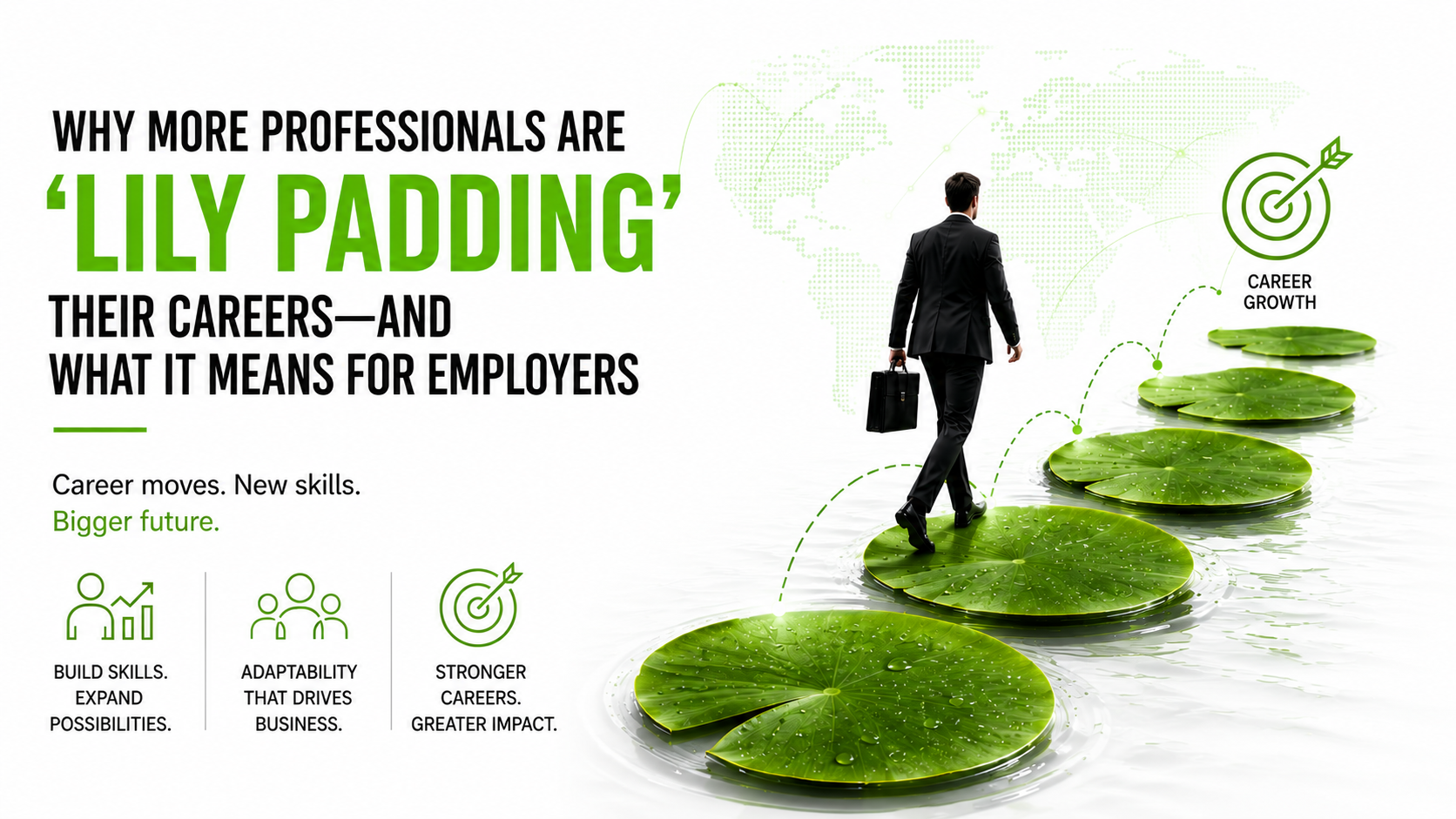
We recently came across an insightful article from Alice Kantor exploring the growing workplace trend known as “lily padding.” The article examines why more professionals—particularly those earlier in their careers—are making strategic career moves to broaden their skills, gain diverse experience, and accelerate long-term career growth.
As workforce expectations continue to evolve, organizations are increasingly recognizing that career progression is no longer defined solely by long tenure at one employer. Instead, many professionals are prioritizing continuous learning, meaningful work, and opportunities to build a broader range of skills.
For employers and hiring managers, this shift presents an opportunity to rethink how career moves are evaluated and how organizations can attract, develop, and retain ambitious talent in an increasingly competitive hiring market.
A Career Built Through Strategic Moves
Brittany Harris-Nelson describes her career journey as “a frog moving across lily pads,” with each role helping her move closer to the career she ultimately wanted.
Over the course of ten years, she held ten different positions across six universities, gradually building experience in administration, admissions, student advising, and engagement. Today, she serves as an Assistant Director of Student Engagement at Wake Forest University—a position she had long been working toward.
Interestingly, while salary increases were not always dramatic, each move provided opportunities to gain valuable skills, stronger benefits, and broader professional experience.
Her journey highlights an important point: not every career move is about immediate financial gain. Sometimes the greatest return comes through long-term career development.
The Rise of “Lily Padding”
Industry experts have identified “lily padding” as a growing workplace trend, particularly among members of Generation Z.
Rather than remaining in one organization for several years, professionals are intentionally moving between roles to:
- Develop new skills
- Build broader experience
- Increase long-term earning potential
- Access greater career opportunities
Recent workforce data supports this trend. According to Randstad’s 2024 global survey, the average tenure for Gen Z employees during the first five years of their careers is approximately 1.1 years, compared to 1.8 years for Millennials and nearly three years for older generations.
For many younger professionals, career progression is increasingly measured by learning opportunities rather than years spent with one employer.
Does Job Hopping Pay Off?
Research suggests that strategic career moves can positively impact earnings.
A 2025 report by Wealthify found that individuals who changed jobs four or more times during the previous decade earned an average salary approximately 31% higher than those who remained in fewer roles.
While salary is not the only motivation, many professionals view each move as an opportunity to strengthen their experience and position themselves for future advancement.
The emphasis is shifting from loyalty alone toward continuous professional development.
Building Skills Across Different Industries
Career expert Adam Smiley Poswolsky is another example of this evolving career approach.
Throughout his career, he has worked across government, education, non-profit organizations, creative industries, and corporate environments before establishing himself as an author and keynote speaker.
Rather than viewing each role independently, he considers every position a building block that contributed new knowledge, transferable skills, and valuable professional perspectives.
His experience reinforces an increasingly common mindset: career progression is no longer always vertical—it can also be diverse and multidimensional.
What Employers Are Seeing
HR and workplace leaders are also observing changing employee expectations.
Many younger professionals are looking for:
- Faster skill development
- Greater variety in their work
- Clear opportunities for growth
- Meaningful career experiences
Rather than expecting employees to remain in one role for many years, organizations are increasingly recognizing that continuous learning and internal mobility play an important role in retention.
Creating opportunities for employees to develop new capabilities may become just as important as offering competitive compensation.
What This Means for Recruitment
For recruiters and hiring managers, the rise of “lily padding” calls for a more balanced approach when evaluating candidates.
A resume with multiple career moves does not necessarily indicate instability. In many cases, it reflects intentional career development and a proactive effort to gain broader experience.
The key is understanding why candidates changed roles and what they gained from each move. Professionals who have consistently built relevant skills across different positions may bring adaptability, resilience, and diverse perspectives to their next employer.
Final Thoughts
The traditional career ladder is evolving. Today’s professionals are increasingly focused on building careers through continuous learning, varied experiences, and purposeful career moves.
For employers, adapting hiring strategies to recognize this shift can help attract ambitious talent while creating workplaces that encourage long-term development.
Rather than asking “How long did this person stay?”, organizations may benefit more from asking
“What skills did they gain along the way?”
Author
Alice Kantor is covering workplace trends, careers, employment, and business. In this article, she explores the growing trend of “lily padding” and how strategic career moves are reshaping today’s workforce.
We hope you found this article as insightful as we did. It highlights how changing workforce expectations are influencing career development and reinforces the importance of understanding what motivates today’s professionals.
As always, stay tuned to the Argentus blog for more insights into the evolving world of Supply Chain, Procurement, Logistics, and Operations. If you’re looking to strengthen your Supply Chain team or discuss your hiring needs, feel free to reach out to recruit@argentus.com.


0 Comments