
At Argentus, we’re fortunate to collaborate with Gary Newbury on a number of initiatives focused on operational excellence, leadership, and business transformation. Gary brings extensive experience as an Interim COO and operational transformation specialist, helping private equity firms and portfolio companies navigate periods of change and improve operational performance.
In the article below, Gary shares his perspective on when interim executives create the greatest value, how they differ from fractional and permanent leaders, and why acting early can help organizations regain momentum before performance issues become larger business challenges.
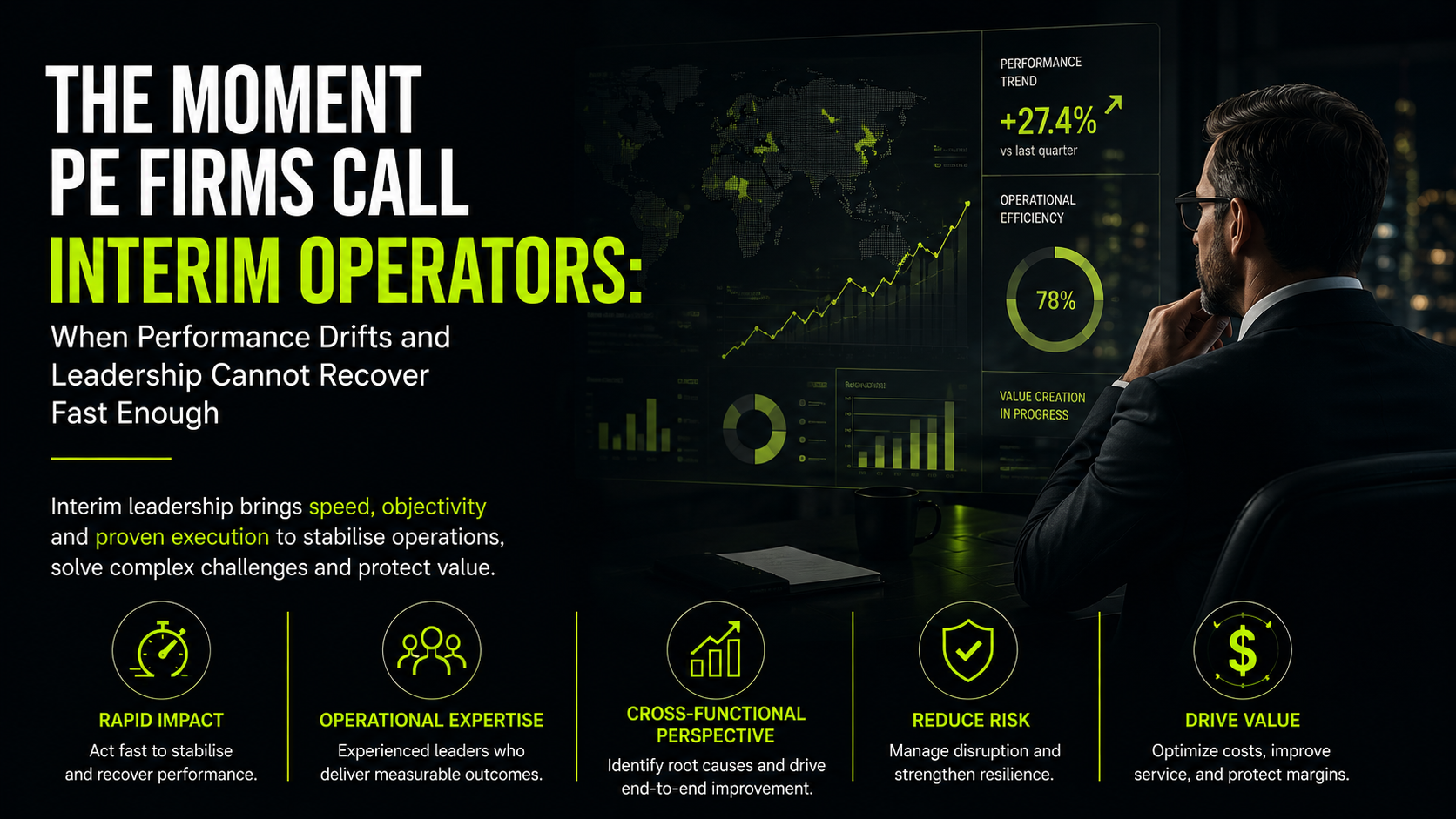
As organizations face increasing pressure to improve performance while protecting enterprise value, interim leadership has become an increasingly important strategic tool. Gary’s article explores when interim executives add the greatest value, how they differ from fractional or permanent leaders, and why acting early can help organizations regain control before operational issues become larger business problems.
Portfolio companies rarely lose value overnight.
More often, value leaks quietly. A missed margin target. Softened service levels. Inventory rises without a clear explanation. A technology implementation fails to yield expected value. The management team still has a story, but the numbers, behaviours, and operating rhythm begin to suggest something different.
That is the moment when the question becomes uncomfortable:
Is this a temporary wobble, or is the business starting to drift away from the value creation plan?
For private equity value creation teams and portfolio company leaders, this is where interim management becomes highly relevant. Not as a generic resource. Not as a fractional adviser. Not as a warm body filling a vacant seat.
A proficient interim executive is brought in to diagnose, stabilise, and drive a specific outcome.
“Most portfolio companies do not collapse dramatically. They slowly drift away from the investment thesis while leadership teams explain why next quarter will improve.”
1️⃣ When interim is the right answer
An interim executive is most valuable when the business needs experienced operational leadership quickly, but the answer is not yet a permanent hire.
That may happen when:
• The portfolio company drifts materially behind plan
• The leadership team cannot explain the performance gap with enough confidence
• A key executive has left or is no longer a good fit for the next phase
• A post-acquisition integration is proving harder than expected
• Supply chain, inventory, service, margin, or execution issues are threatening enterprise value
In these situations, waiting six months for a permanent search can be expensive. Equally, hiring permanently before the root cause is understood can lock the business into the wrong answer.
2️⃣ The difference between interim, fractional, contract, and permanent
These terms are often used interchangeably, but they are not the same.
A fractional executive usually provides part-time leadership, often across several businesses. This can work well where the need is advisory, periodic, or capability-building. Fractional CMOs and CHROs often fill this space well.
A contractor is typically brought in to deliver a defined technical task or specialist workstream.
A permanent hire is appropriate when the business knows the role it needs, has time to recruit properly, and understands the capability and interpersonal profile required for the next stage.
An interim executive sits in a different lane.
The interim is there when the situation is moving, the risk is real, and the organisation needs a focused leadership resource that can step in, assess quickly, create control, and drive change.
“The best interims do not simply occupy the role. They reshape the situation.”
3️⃣ Where PE firms typically need interim support
Interim executives can add value at several points in the PE ownership cycle.
Pre-deal, they may support operational due diligence by assessing whether the business model, systems, leadership, and supply chain can support the investment thesis.
Post-close, they may help stabilise the business, implement the first 100-day plan, or address capability gaps that were not fully visible during due diligence.
Mid-hold, they may be brought in when the business is drifting from plan, when growth is exposing operational weakness, or when a major customer, channel, technology, or cost shift has destabilised performance.
Pre-exit, they may help tighten processes, improve reporting, reduce operational risk, and prepare the business for buyer scrutiny.
Increasingly, PE firms are gaining earlier visibility of operational drift through AI-enabled reporting, predictive analytics, workflow monitoring, and performance intelligence tools. However, while technology may detect deterioration earlier, it still cannot stabilise teams, rebuild operating discipline, align stakeholders, or execute recovery plans. In many cases, AI will accelerate the need for experienced interim operators by shortening the time between identifying drift and demanding corrective action.
In each case, the trigger is not simply “we need someone.” The trigger is usually “we need control, clarity, and rapid resolution.”
4️⃣ Who makes the decision?
This is where PE dynamics become important.
Sometimes the PE firm drives the decision. The value creation team may see the performance risk before the portfolio company fully accepts it. In more urgent cases, the investor may insist that external interim support is brought in.
In other cases, the portfolio company leadership team recognises the gap and asks for help. The PE firm then supports the budget, introduces trusted candidates, or works with an interim management provider to source the right capability.
Alternatively, the portfolio company may take the initiative, find an interim management provider and secure an interim executive with a specific track record to drive the required outcome, advising the PE value team with their strategy and choice.
Neither route is inherently better. What matters is that the decision is made early enough to positively impact value.
By the time the issue is obvious to everyone, value has often already been lost.
5️⃣ What PE firms and portfolio companies should look for
The best interim candidates are not simply people between permanent jobs.
They have pattern recognition cognition. They know how underperformance shows up before it becomes a crisis. They can work with incomplete information. They can read the commercial, operational, financial, and human dynamics quickly. They can operate with authority without needing months to build political capital.
The recruitment question should not be:
“Who has done this job title before?”
It should be:
“Who can walk into this situation, diagnose what is really happening, align key stakeholders, and move the business back toward plan, rapidly?”
That is why selecting a strong interim management provider (IMP) really matters. The IMP role is not just to fill a vacancy. It is to understand the situation, interpret the pressure, define the assignment, and connect the business with an operator who can deliver the required outcome.
In pressured environments, the right interim does not create dependency. They create momentum, transfer capability and knowledge, and leave the organisation much stronger than they found it.
Private equity firms are measured on value creation. Portfolio companies are judged on execution. When performance starts to drift, both sides need a way to act before the issue becomes a formal turnaround.
That is where interim management earns its place.
Not as coaching. Not as consulting theatre. Not as role-filling.
As urgent, outcome-led leadership when the plan is starting to wobble and value needs protecting.
Author
Gary Newbury is an Interim COO and operational transformation specialist with extensive experience helping organizations improve operational performance, execute transformation initiatives, and support private equity portfolio companies through periods of change.
We hope you found this contribution as insightful as we did. It highlights the growing importance of decisive leadership during periods of operational uncertainty and reinforces how strong execution remains central to Supply Chain and Procurement success.
As always, stay tuned to the Argentus blog for more insights into the evolving world of Supply Chain, Procurement, Logistics, and Operations. If you’re looking to strengthen your Supply Chain team or discuss your hiring needs, feel free to reach out to recruit@argentus.com.
0 Comments