
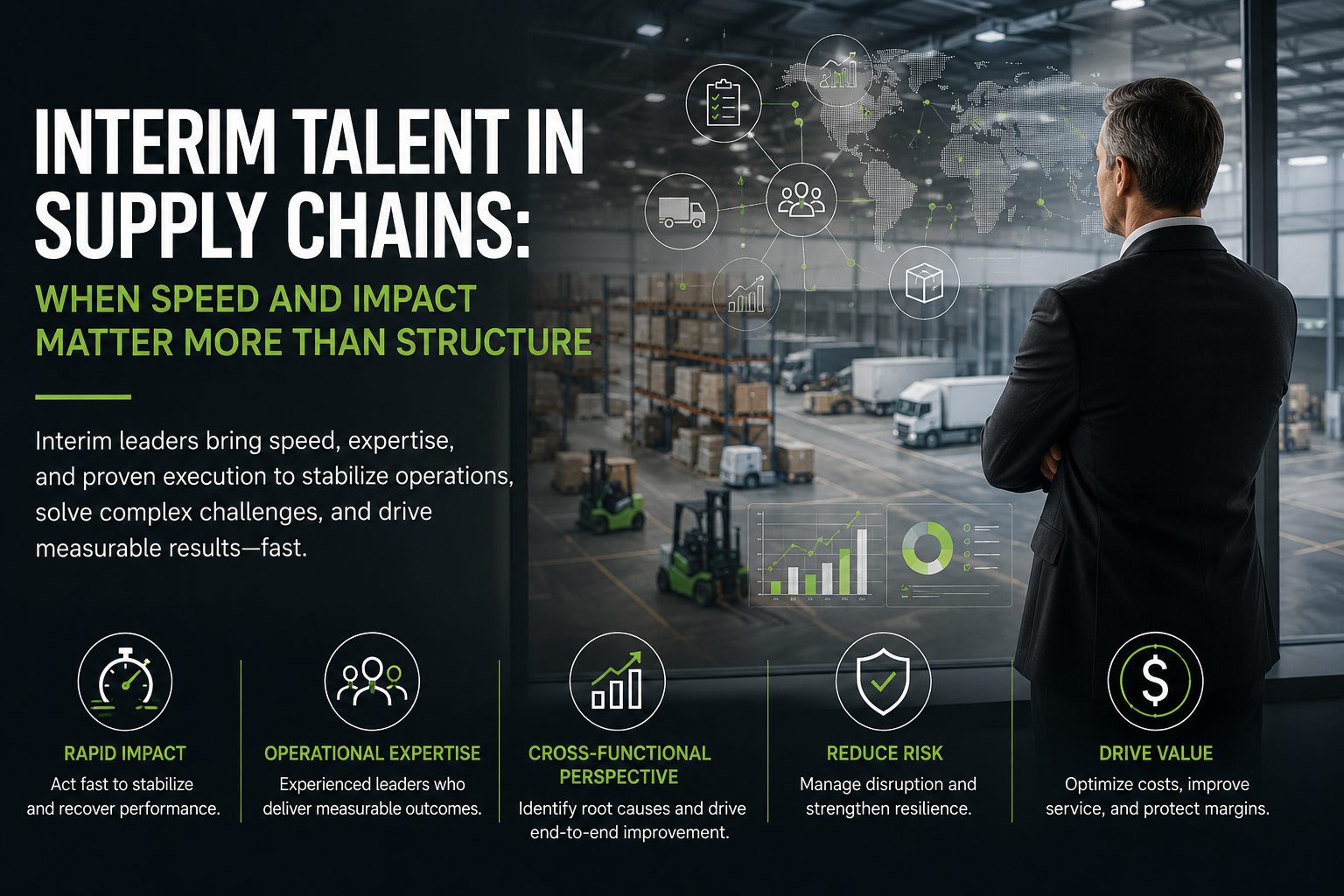
We recently came across a thoughtful contribution from Gary Newbury discussing the growing importance of interim leadership across Supply Chain and Procurement functions.
As operational complexity, transformation pressure, and disruption continue to impact organizations, more companies are turning to interim executives to stabilize performance, accelerate execution, and drive meaningful operational change.
This perspective is a timely reminder that in today’s Supply Chain environment, speed and execution can often matter just as much as long-term structure.
Supply chains rarely fail overnight.
They drift.
Service levels soften. Inventory builds in the wrong places. Warehouses become congested. Transport costs creep upward. Procurement decisions made under pressure start to show up later in margin erosion and customer dissatisfaction.
By the time leadership teams recognize the pattern, the issue is no longer isolated. It is systemic.
This is the point where organizations face a critical decision.
Build capability internally. Hire permanently. Or bring in external expertise to stabilize and reset performance.
More mid-market firms and private equity-backed businesses are now turning to interim executives to deal with these moments.
What Interim Leadership Really Means in a Supply Chain Context
Interim management is often mistaken for short-term cover.
It is not.
An interim executive is deployed to deliver a defined outcome within a fixed period, usually where time, performance, and risk are tightly linked.
In Supply Chain environments, this includes:
- Stabilizing warehouse operations where service levels have dropped
- Resetting inventory control after rapid growth or poor visibility
- Recovering ERP or WMS implementations that have disrupted planning and execution
- Rebuilding transport networks where cost and service are misaligned
- Leading procurement reset programs to address margin pressure or supplier instability
These are not advisory situations.
They are execution challenges that require immediate traction.
When an Interim is the Right Move
Permanent hiring plays an important role. However, in moments of operational pressure, it is often too slow.
Recruitment cycles take time. Onboarding takes longer. Internal dynamics can dilute early decision-making. Meanwhile, performance continues to decline.
An interim changes that dynamic.
Organizations typically benefit most when:
- Performance has already slipped and requires rapid stabilization
- Transformation programs are losing momentum
- Leadership gaps exist in critical operational roles
- Growth has outpaced capability, exposing structural weaknesses
- Technology deployments have created disruption instead of improvement
In these situations, the value of an interim is not just experience.
It is speed of mobilization and clarity of action.
Why Interim Leaders Deliver Differently
The difference is not just capability. It is perspective.
Interims are not shaped by the internal narratives of the organization. They are not tied to legacy decisions or historical ways of working.
They bring:
- Pattern recognition from similar situations across multiple organizations
- Independence from internal politics
- A bias toward action rather than prolonged analysis
- Clear accountability for defined outcomes
In Supply Chain environments, where Procurement, inventory, warehousing, and transport are tightly linked, this ability to move quickly across functions is critical.
What looks like a warehouse issue is often driven by forecasting, purchasing, or network design. An experienced interim focuses on the root cause, not just the visible symptom
Interim vs Fractional vs Contracting
Clarity matters.
Interim Executives
Full-time or near full-time. Brought in to deliver defined outcomes under time pressure.
Fractional Executives
Part-time. Provide ongoing strategic input over a longer period.
Contracting
Task-based delivery such as system configuration, data work, or project execution.
In high-pressure Supply Chain situations, interim leadership is the correct lever when execution speed and impact are the priority.
How to Access the Right Interim Talent
This is where many organizations hesitate.
Strong interim leaders are not typically active job seekers. They operate within specialist networks and are often deployed quickly when the right mandate appears.
This is where specialist recruitment firms such as Argentus play a critical role.
Firms like Argentus focus on Supply Chain and Procurement talent and maintain access to experienced, battle-tested interim leaders who have delivered in complex environments.
Rather than running a traditional recruitment process, they can:
- Identify proven interim operators with relevant experience
- Validate track record against similar operational challenges
- Provide rapid shortlists aligned to the specific outcome required
- Advise on the structure of the mandate to ensure success
For organizations under pressure, this significantly reduces time to impact.
How to Select the Right Interim
Access is only part of the equation. Selection matters just as much.
A few practical principles:
Define the Outcome Clearly
Be specific. Service recovery. Cost reduction. Inventory release. System stabilization.
Clarity drives speed.
Prioritize Delivery Over Credentials
Look for individuals who have already solved similar problems, not those who understand them in theory.
Test Commitment to the Interim Model
Strong interims are not in transition between permanent roles.
They are specialists in entering complex environments, delivering results, and exiting cleanly.
Provide Access and Authority
They need access to data, people, and decision-makers from day one.
Ensure Executive Sponsorship
Without clear backing, momentum will risk stalling.
A Strategic Lever, Not a Stopgap
Interim leadership is not a temporary fix.
It is a deliberate decision to restore control, accelerate execution, and protect performance.
In Supply Chains, where disruption spreads quickly across the business, the ability to act early and decisively is critical.
The organizations that use interim talent well do not wait for failure.
They recognize drift early.
They act quickly.
They bring in the capability required to reset performance.
And they move forward with control.
Author
Gary Newbury is an Interim COO and Supply Chain transformation specialist focused on rapid performance recovery across mid-market businesses.
We hope you found this contribution as insightful as we did. It’s a strong reminder that in today’s Supply Chain and Procurement environment, operational performance often depends on how quickly organizations can respond to disruption, complexity, and change. As always, stay tuned to the Argentus blog for more insights into the evolving world of Supply Chain, Procurement, Logistics, and Operations. If you have any hiring needs or are looking to strengthen your Supply Chain team, feel free to reach out to Argentus at recruit@argentus.com.

0 Comments